
Christopher Nolan's Odyssey is not Homer's
It is still a civilizational triumph.


SPEAK, MEMORY
Of the cunning hero,
The Twitter discourse, blown off course time and again
Before any had glimpsed the plundering of Troy’s sacred heights.
For all the good and bad faith currently taking up oxygen in this blessedly rare moment of mono-culture, let’s make the obvious clear: Nolan’s Odyssey is not Homer’s.
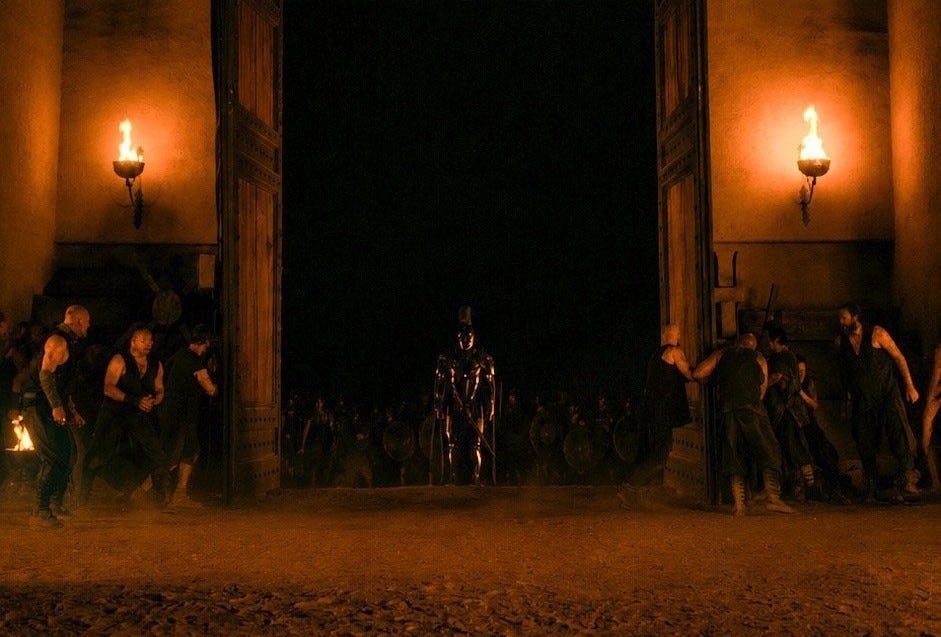
It is, still, a masterful feat of filmmaking. It hits transcendent notes. You can put the sacking of Troy and that third act up against any blockbuster experience.
That the film includes a posthumous dedication to Nolan’s friend and IMAX mentor, Canadian David Keighley, inventor of the film’s “Keighley camera,” is a beautiful tribute to the craft, to pushing the envelope, and to the care that went into its production.
Has the interpretation landed with every scholar, Classics fan, or those on right-wing identitarian Twitter? No. Its themes, narratively, confuse themselves a time or two. There is a tension between pleasing a modern audience and the man Odysseus is supposed to be. Should we be grateful that it exists, that it brings the epics to new generations, and that even the average filmgoer is giving such heady fare an A CinemaScore? Absolutely.
Which leads to another point in need of being made clear.
The digital outrage machine tends to operate, increasingly, on a tireless, Pavlovian schedule. The pre-outrage to The Odyssey, particularly after its more recent trailers, was loud, fierce, and entirely predictable—fixating almost exclusively on the color-coding of the casting choices. To some of the internet’s loudest engagement farmers, it looked like yet another foundational institution of Western civilization was about to be sacrificed on the altar of modern Hollywood sensibilities. “Go woke, go broke.”
However, now that the film is being pulled forward adoringly by the public, like a two-tonne hollow horse across the sand, that hyper-reactive experience in pre-supposition not only embarrassed itself, it embarrasses the political movement associated with the anon accounts most angry with the film, often without having even watched it. An anticipated $1 billion global box-office haul will do that to you.
Pre-release, accounts whipped up a frenzied narrative based on outright falsehoods, claiming that Elliot Page had been cast to play the ultimate hyper-masculine warrior, Achilles, who doesn’t appear in the film.
In reality, Page was cast as Sinon—an important, albeit far lesser mythological figure from Virgil’s Aeneid. Page’s screentime? 5 minutes.
Yet, to stop the analysis there would be to mistake the edge of the wooden horseshoe for the monster-laden horizon.