
'We need an [immigration] outflow plan beyond just the honour system'
Acceptable Views goes to Parliament. (Virtually.)

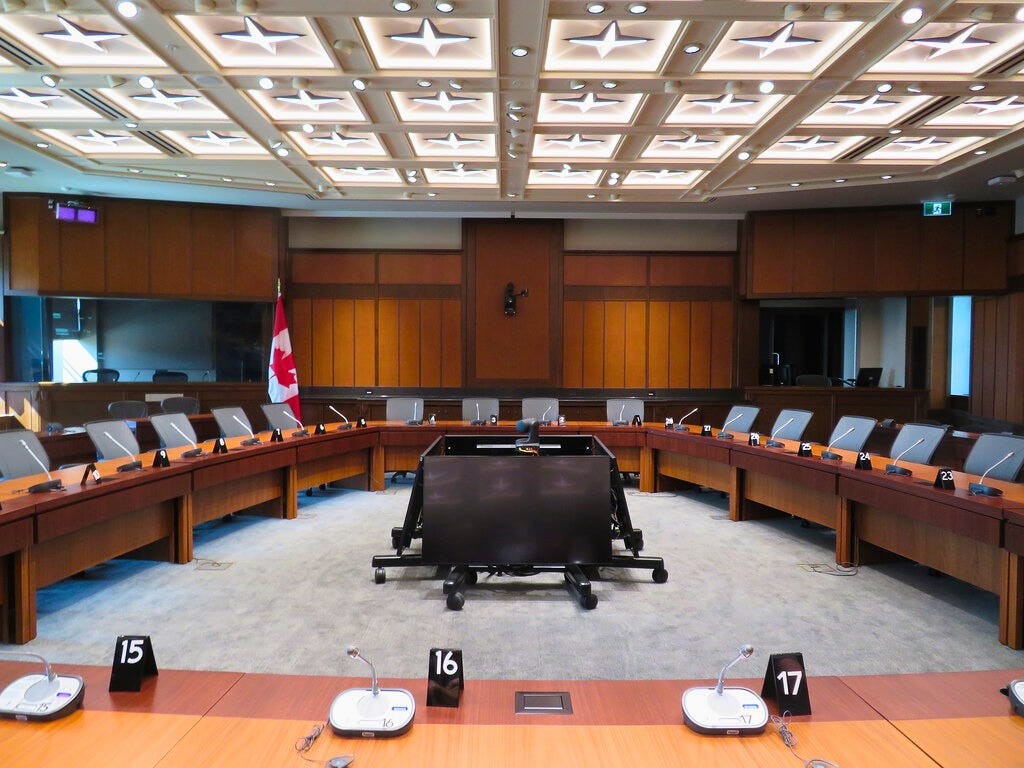
The year of firsts continues around these parts. The show on Juno News is going well, the public-speaking circuit beckons, Without Diminishment can’t go a day without stirring up coverage (or consternation), and yesterday, I appeared before the House of Commons’ Standing Committee on Citizenship and Immigration, to better advocate on behalf of the Canadian worker, and the majority of Canadians who know that revised Liberal targets still amount to north of two-million over three years, with a limited exit plan for the millions from the ‘Fraser wave’ of temps and foreign students.
Those numbers, of course, aren’t good enough, not when our infrastructure is stretched beyond the brink, as you’ll see referenced below, and not when our society continues to Balkanize and turn inward on itself in its hostilities, like a circular firing squad.
A scarcity mindset has taken over, a degree of alienation and fatigue, which won’t improve unless we deal with the principal issue that tipped our housing, employment, healthcare, and identity crises into some five-alarm affair: the Liberals’ plan to break our immigration standard — first dreamed up by Dominic Barton, then of McKinsey, along with the rest of Canada’s worst — and then the implementation phase, starting around 2018, before shifting into sixth gear in 2021.
You’re welcome to join me in my testimony below, and to read my remarks. For viewers, I stick around for a round of questioning before the Bloc moves a motion that sends the witnesses home.
As ever, thanks for being here, and for supporting work, started back in 2022, that’s now finding its way to Parliamentary committee.

Watch my testimony at 16:46:09 on ParlVu, or clipped on Twitter/X.
Thank you, Members of committee. My name is Alexander Brown and I’m the Director of the National Citizens Coalition, one of Canada’s pioneering non-profit advocacy groups.
Today, there are few issues that animate Canadians more than immigration, a system that worked all but seamlessly into the 2010s. David Coletto of Abacus Data presently has it as the #4 pocketbook issue for young Canadians, and #6 overall.
In a recent study from Environics, A majority of Canadians continue to say there is too much immigration . . . Those who express this view increasingly point to poor government management as the problem.
In a recent poll from Leger, most immigrants want fewer than 300,000 immigrants annually, lower than outlined in the budget.
It’s not hard to see why that concern isn’t going away. Our revised immigration plan doesn’t solve for Canada’s sudden overcapacity problem. What we have in land we lack in basics.
500,000 Canadians walked out of emergency rooms last year without receiving care. That’s data from CBC Marketplace. That’s 5-15% of all ER attendees.
1 in 5 Canadians are without a family doctor, according to the latest from Angus Reid, which is of major concern to the Canadian Cancer Society, who partnered on that poll.
In additional recent analysis, think-tank Second Street has north of 23,000 Canadians dying on waitlists over the past year.
The youth unemployment rate reached 15 per cent in September according to StatsCan — the highest level since 2010, excluding the pandemic years. Over the summer in Toronto, youth unemployment cracked 20%.
According to the CMHC: 2025 is on track to set a 30-year low in housing starts.
I open with facts and figures, with all the requisite ‘experts say’, because we need to avoid disqualifiers, excuses, and mischaracterizations. We need to get this fixed.
To borrow from a terrific Jamie Sarkonak column, turning down the taps won’t unflood the basement. And all we’ve done is turn down the taps.
On the Temporary Foreigner Work and International Mobility Program front, myself and Immigration expert Dr. Michael Bonner, who once worked in service on this file under Stephen Harper and Jason Kenney, we’ve argued in The Hub that: “It wouldn’t be wrong to view these programs as distortionary government subsidies or welfare for unproductive businesses. The effects disproportionately harm younger Canadians who are priced out of the labour market, given that temporary workers overwhelmingly earn less than the median wage. And yet, we’re constantly hectored about labour shortages, Canadians’ ‘unwillingness’ to do certain jobs, and the need for foreign workers.
“It shouldn’t take much intellectual effort to see that the use of foreign labour and the difficulties of employing younger Canadians are two sides of the same ugly coin. Foreign workers are more cooperative because they are bound to their employers like serfs and they face barriers to joining unions…”
The U.N. branded our abuse of those programs as a “contemporary form of modern slavery” for a reason, and downstream from that grotesquerie, our domestic population struggles. If you have young people in your lives, if you talk to students when they visit the Hill, they’re sending out hundreds of resumes and going nowhere -- that means securing stable income later, struggling below the mean, having children later, and they’re unable to afford homes and down payments.
We’re extending their adolescence, and it’s in large part due to blowing the doors off our inflow as of 2021 to grow in numbers but not productivity. Our young and working aged are in direct competition with north of three-million visitors, many in the low-wage and low-skill stream, and we need an outflow plan beyond just the honour system.
The NCC and its Canadians for Responsible Immigration campaign is calling for the following:
Abolish the Temporary Foreign Worker Program for all but the hardest-to-fill seasonal agricultural and construction and engineering roles.
Safeguards to prevent the ‘diploma mill’ eruption witnessed post-2020
Close asylum loopholes
Lower Permanent Residency targets
Strengthen deportation policies, and deport all non-citizens convicted of serious crimes
Country caps
Prioritize high-value students
Reform the points system
Implement a Canadian Birth-Rate Strategy, and make Canada less reliant on immigration for population growth
Extend the time-period to citizenship
And I close with this: our immigration system has never been set by our business lobby. When you go to a barber and ask them if you need a haircut, what do we expect them to say? For everyone in your ear telling you they want to return to the moonshot of the last few years, or who want to amnesty as many from the Covid wave as possible, I implore you to say no.
Say no for the students and grads sending out 100s of resumes. Say no for the 15 foreign students, sold a lie, living in a basement sharing a single washroom. Say no on behalf of the victims of migrant crime.
Canadians are telling you they want a return to responsible immigration, that they’re counting on an exit strategy for millions on set-to-expire status, and that revised targets aren’t yet going far enough. Will we listen?
For more on immigration, read my latest in Without Diminishment:

And join myself and Immigration Critic Michelle Rempel Garner on Juno News:
A tremendous presentation Alex. It is pithy, pertinent and perspicuous - even for pea-brained politicians.
As if the immigration problem wasn't enough, today we have received word that roughly half of Ontario's grade six students didn't meet the provincial standard in math. That begs many questions about the abilities of the teachers, who have been accused of indoctrinating instead of educating, and what societal issues will arise if the situation isn't improved. Perhaps the folks who believe that "math is racist" can be asked to provide a solution.