

I was ten years old when my father offered Stephen Harper a job.
Little did I know at the time, but while I was up in the computer room prompting eventual cease-and-desist letters from Napster, or pretending to be Sergei Berezin while roller-blading around our midtown Toronto driveway (now a luxury and an impossibility for the hyper-majority of working families), that the two young men who would swap political war-stories over a beverage in our backyard would end up holding such an outsized influence on Canadian conservatism.
In the case of my father, Colin T. Brown, a true throwback who ran out to qualify for his pilot’s licence the second he turned of age, it would be of little interest to him that he’s never received more public credit for his work behind the scenes. He has dined with presidents, sat on the country’s top boards, and been approached a fair share of times to run, but never lost sight of his priorities. Those who know, know.
Like my grandfather, Colin M. Brown, who founded the National Citizens Coalition (NCC) in the 1960s – effectively launching the third-party non-profit political advocacy model in Canada that’s now such a mainstay – the two were often told by premiers, MPs, MLAs, that they were “worth more on the outside” than they were if they ran as capital-C Conservatives. Every few years they would be asked, some senior official or politician would rush to warn them that they would lose their ability to help shape movements and expand what we now refer to as “social licence,” and they would respectfully decline.
We’re conditioned to believe that all those working in the supposed ‘shadows’ – in the shadow of the birch tree in the backyard of my childhood home, in this case – are working against us. In the case of the Liberal decision to break immigration, legitimately dreamt up over a weekend at Dominic Barton’s cottage, that is one such example.
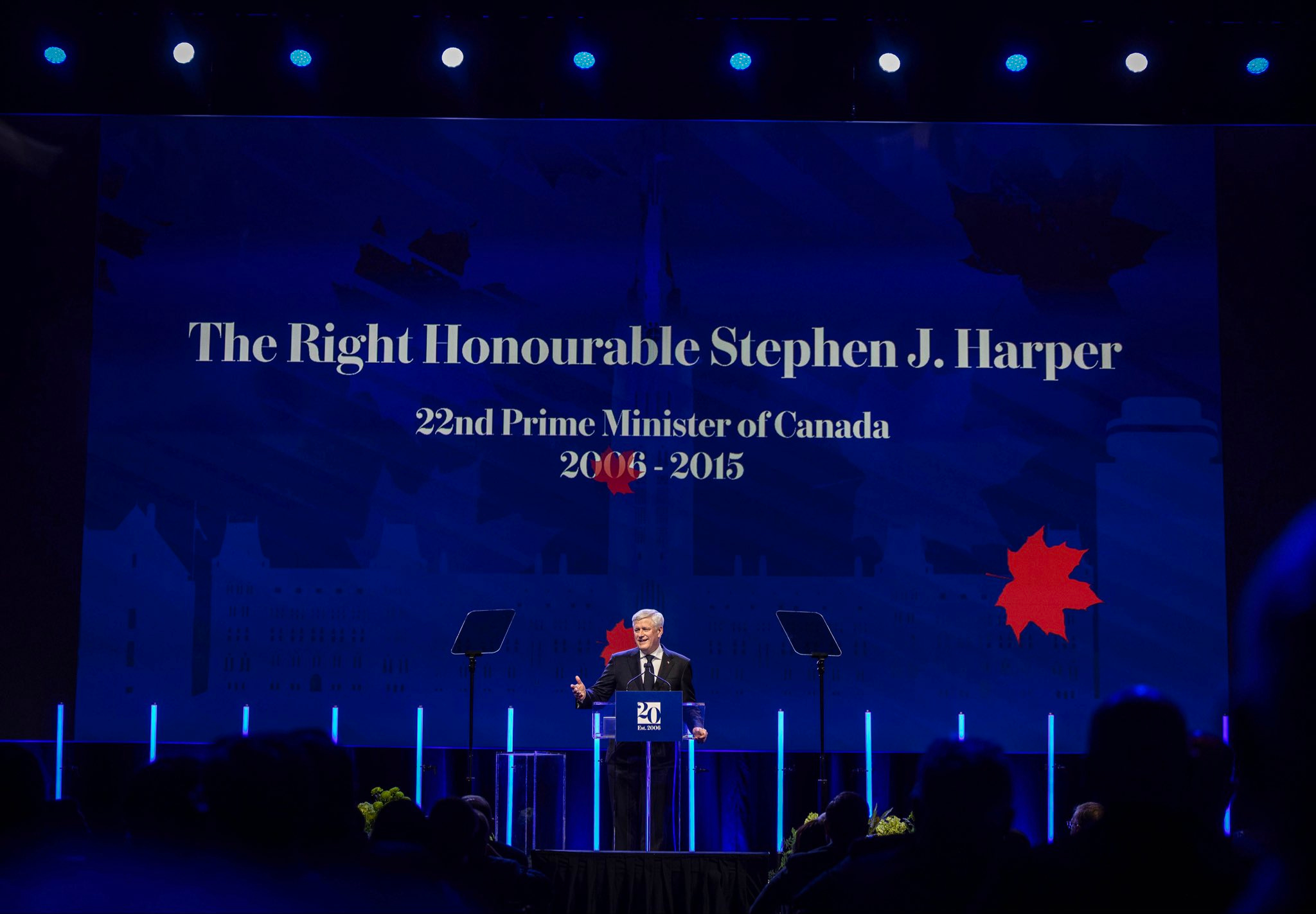
In the case of Stephen Harper, now the Right Honourable, now having been deservedly feted at ‘Harper20,’ or ‘Harperpalooza,’ as was the popular moniker at convention week in Calgary, this was a man who stubbornly kept it above-board, and against all odds turned defeat into an opportunity for enormous growth.
Harper took that job from my father in 1998, graciously served as a caretaker for my grandfather’s legacy and as a bulwark against the worst of big government excess, and in 2002 knew that it was time to venture back out to unite the right, and to set this country up for a dearly missed nine-and-a-half years of blissful competence, that was so unfortunately followed by a decade of antithesis.
Consider it deep personal bias if one must, but it would take a particular brand of cynic to continue to hold any form of animus towards those Harper years. Liberals will quietly tell you they “had no idea how good we had it.” Mark Carney privately admired the man, and both his remarks and general decorum in celebrating the Right Hon. this week are to be commended. The results with Carney may be lacking, he may not be the best team player, he may speak fluent ChatGPT, but he holds himself with a grace and dignity that was sorely lacking in He Who Shall Not Be Named. Carney is legitimately charming as any portfolio manager must be, and he’s good at being prime minister. And he should be, he’s been training his entire adult life for this moment.
It would also take a particular brand of cynic coming out of Pierre Poilievre’s leadership address to the Conservative convention to suggest that wasn’t enough. As I stated in a walk-and-talk on the convention-room floor in the immediate aftermath, it largely struck the right notes. Poilievre rightly did not abandon the culture wars, but there was also an attempt to show a hint of contrition for mistakes made, and moments that were perhaps missed.
I’m very much of the opinion that both black swan bad luck, and the total collapse of the NDP, do not a failed Official Opposition make, but there are lessons in defeat that Mr. Harper would go out of his way to learn. Poilievre must show himself capable of doing the same. His team understands this, it’s another thing to show that to our electorate, who, as we know, are quick to judge, and startle easily. ‘Reform’ scares them, even when it’s to make Canada more like the 1990s, not the 1990s some pretend still exist. My advice is don’t dump the young, working class coalition (and they won’t). But, we need a kind of counter-elite, to scale back on some of the “boots not suits” rhetoric, to not “axe the tax” for longer than is necessary, those are all adjustments that can be made.
And say the ‘T-word’ more often, even if it’s performative. On Monday, I was on the radio with Greg Brady bright and early following the return flight from Calgary, and I don’t think I’m speaking out of turn by saying the two of us were of the shared mindset, along with a few other prominent party figures, that you have to meet portions of our electorate where they are, not where you wish for them to be.
No leader inside that inner circle wants to take their eyes off domestic issues, but Carney’s entire voter bloc prioritizes Trump over acknowledging that the kids have had the ladder pulled up from over their heads, and have been tasked to live in dystopian, post-national, anti-abundance. Find five minutes of twenty-five for the American president. Speak a full-hearted defence of those who make their final journey down our Highway of Heroes. That was a missed opportunity, not deliberately so, but a missed opportunity nonetheless.
It’s in this moment in the media, advocacy, third-party, non-profit, big tent space, that we’re very much trying to not miss our own opportunity. In growing and expanding within whatever our spheres of influence may be, like working private salons, holding our own events, and having our own versions of back-yard powwows, if these end up being ten-percent as impactful as those shared by my father and Mr. Harper, I’d consider that a success.
With no discernable path to federal Conservative results on the horizon, it would be easy to go negative, and easiest of all to give up. It’s harder to build, to put oneself out there, and to accept wins or losses, no matter which comes first. Stephen Harper had to lose to win. In that gulf between defeat and success, where far too many turn back, turn sour, or harden around the absence of what no longer is, he built relationships, bridges, an entire political movement.
Such lessons aren’t just for Pierre Poilievre. Losing isn’t a choice. To live in loss is. Movements can grow anywhere, even out your back window. But you have to move.
This column originally appeared in Without Diminishment, and is running here with permission and attribution.
Alexander Brown is the Managing Editor of Without Diminishment, Director of the National Citizens Coalition, a host on Juno News, a contributor to Project Ontario, and the writer of Acceptable Views.
“…..quick to judge, and startle easily.” Sad but true. Many thanks to you and your family. I extend my gratitude.
Excellent Alex!
Having known your Dad for more than fifty-years now, I know that he is mighty proud of what you are accomplishing. Having spent enjoyable dinners discussing business and politics with your Grandfather during my time at Western, I believe that he would be most appreciative and excited about your work.